The Presiding Bishop of The Methodist Church Ghana, the Most Rev. Prof. Johnson Asamoah-Gyadu, has warned against the growing practice of publicly shaming people, following the death of Ghanaian-born Cambridge University professor Jason Arday.
In a statement posted on his official Facebook page, Most Rev Prof. Asamoah-Gyadu described the death of the young academic as tragic, coming at a time when controversies surrounding his personal and academic life had yet to settle.
He expressed concern about the possible impact of the intense media, social media and academic scrutiny Prof. Arday had faced.
“It is impossible to miss the fact that the media, social, and academic scrutinies that the young man had to go through may have contributed to this unfortunate situation,” he wrote.
Presiding Bishop noted that the growing use of social media has made public shaming increasingly common, often without consideration for its impact on those involved and their families.
He noted that the effects of such public scrutiny could be overwhelming not only for those at the centre of controversies but also for their families.
Presiding Bishop drew on the biblical account of Jesus and the woman caught in adultery to illustrate how society should respond to people who find themselves in difficult situations.
He said Jesus did not excuse the woman’s behaviour but also did not allow her to be destroyed by public condemnation.
“Jesus did not excuse her behavior. She overturned the shame on to her accusers and gave the woman another chance to live,” he said.
He urged the public to think carefully about the consequences of publicly shaming others, particularly when they are going through difficult circumstances.
“The next time you are tempted to shame others publicly, think about its effects on them and their loved ones,” he said.
He described Prof. Arday’s death as tragic and prayed that his soul would “rest in the Lord’s peace.”
Read the post below
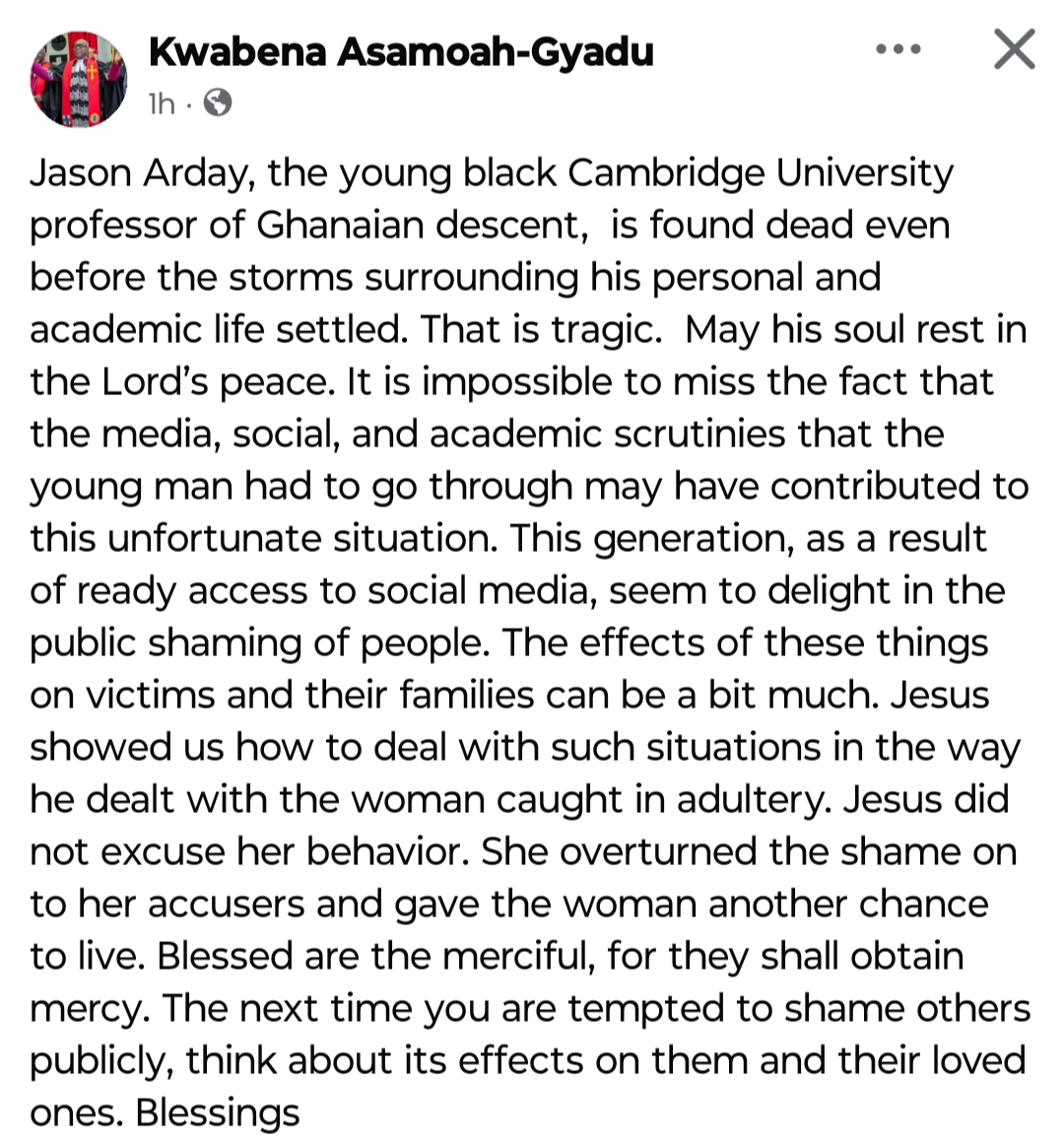
Scrow down to read the full story behind the death of Professor Jason Arday
Background
Jason Arday, a former professor of sociology of education at the University of Cambridge, was found dead at the age of 41, days after resigning from his position amid allegations of plagiarism and questions about aspects of his academic work.
Emergency services found a man unresponsive at an address in Battersea, south London, on Friday afternoon. The Metropolitan Police said his death was unexpected but was not being treated as suspicious.
Arday had denied deliberately plagiarising academic work but acknowledged errors in some of his earlier publications. He said some of the mistakes were linked to how, as an autistic academic, he used mimicry to process and understand information.
The controversy intensified in the weeks before his death following scrutiny of his academic work and allegations raised by another academic. Arday said the level of public criticism had gone beyond legitimate scholarly disagreement and placed significant strain on him and those close to him.
He resigned from Cambridge the previous week, saying the personal cost of the controversy had become too great. He maintained that his resignation should not be interpreted as an acceptance of the allegations made against him.
Cambridge had previously said concerns about Arday’s doctoral thesis and some journal publications had been examined by Liverpool John Moores University and the relevant journals. Liverpool John Moores University, which awarded him his PhD in 2015, concluded that he had not plagiarised.
Despite that finding, Cambridge announced an independent investigation into the circumstances surrounding his appointment. The university said the review would be conducted by senior academics from within and outside Cambridge.
Arday was appointed a professor at Cambridge in 2023 at the age of 37, becoming the university’s youngest Black professor at the time. His appointment had been widely viewed as significant given the low representation of Black academics at professorial level in UK universities.
Following his death, friends, former colleagues and public figures expressed shock and concern over the intense scrutiny he faced in the final weeks of his life.
Professor Kehinde Andrews, a friend of Arday, said he had been deeply distressed following his resignation and had become increasingly withdrawn.
Before joining Cambridge, Arday worked as a physical education teacher and later held academic positions at Durham University and the University of Glasgow.
Both universities expressed condolences following his death. Glasgow also announced a review of Arday’s previous academic work.
Arday’s life story was also the subject of his memoir, Great and Unfortunate Things, which recounts his childhood challenges, academic journey and eventual rise to professorship. The book was released in the United States earlier this month and was due for publication in the UK later in August.

Investigative Journalist & News Editor:
(Wesleyan Television)
Contact: Editor@wesleyannews.com
Source: Wesleyannews.com
Do you have a story to share? Send it to our editorial team at editor@wesleyannews.com