Ghana’s passport administration system is facing scrutiny following allegations that officials within the Ministry of Foreign Affairs and the Passport Office facilitated the irregular issuance of Service and Diplomatic Passports to unqualified individuals in exchange for money.
The controversy has sparked political disagreements in Parliament and calls for an independent investigation into what the Minority describes as a wider network involving public officials and intermediaries.
At the centre of the allegations are claims that applicants were assigned false official positions, supported with forged documents and helped to obtain special travel documents they were not entitled to.
The Ministry of Foreign Affairs has so far confirmed that 10 Service Passports were irregularly issued and subsequently cancelled. Two officials have also been interdicted and referred to the Ghana Police Service for further investigations.
However, the Minority alleges that the operation could be much bigger, claiming that about 300 Ghanaians may have travelled abroad using passports obtained through the arrangement.
How the scandal came to light
The Ministry says investigations began after it received two petitions concerning the alleged irregular issuance of Service Passports.
According to a statement issued on November 8, 2026, the first petition was received on October 8, with another complaint subsequently drawing attention to an alleged network operating within the passport administration system.
One petitioner claimed to have paid 29,000 US dollars in connection with an arrangement dating back to 2023, while another alleged that 5,000 dollars was paid to members of the network in 2026.
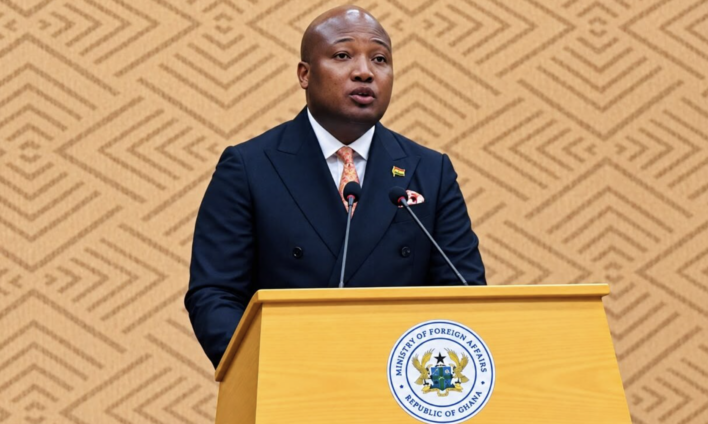
Following the first petition, Foreign Affairs Minister Samuel Okudzeto Ablakwa directed the formation of an investigative committee on October 13 to establish the circumstances surrounding the alleged irregularities.
Preliminary findings identified 10 individuals who had allegedly obtained Service Passports irregularly between January 2023 and August 2026.
The Ministry subsequently cancelled all 10 passports and interdicted two officials suspected of involvement.
Who has been implicated?
The two officials interdicted are the Acting Director of Passports, Mahama Yahaya Amantana, and a junior Foreign Service Officer, Alhassan Sumani.
The Ministry has identified Sumani in the petitions as the alleged mastermind of the operation, claiming he previously worked as a middleman, popularly known as a 'goro boy', within the passport administration system before joining the Foreign Service on November 29, 2024.
Both officials have been referred to the Ghana Police Service for further investigations and possible prosecution.
The Ministry has also indicated that retired Ambassador Mohammed Habib Idris, who served as Director of Passports during the period in 2023 when some of the alleged irregularities occurred, would be investigated by the security services and sanctioned if found culpable.
Meanwhile, presidential aide Dr Samuel Ayeh has disclosed that a suspect identified as Wale allegedly confessed to forging the signature of a former Chief Director to facilitate the issuance of Service Passports.
Dr Ayeh said the suspect admitted before the investigative committee that he had forged signatures on official letters used to secure the passports.
He further alleged that Sumani was responsible for obtaining the letterheads used in the process.
According to Dr Ayeh, the committee has an audio recording of the alleged confession, with its report expected to be published the following week.
These claims are yet to be tested through the full investigative and legal processes.
How did the alleged passport-for-sale scheme operate?
While the Ministry's preliminary findings have focused on 10 irregularly issued Service Passports, the Minority in Parliament has presented allegations suggesting a wider network involving officials, intermediaries and travel agents.
Addressing a press conference on November 8, the Ranking Member on Parliament's Foreign Affairs and Regional Integration Committee, Samuel Abu Jinapor, alleged that some officials within the Ministry and Passport Office operated a travel and tour business through which customers were assisted to obtain Diplomatic and Service Passports.
According to him, the arrangement involved assigning applicants official positions and designations they did not hold to make them appear eligible for the documents.
The Minority cited letters purportedly issued on behalf of the Foreign Affairs Minister approving applications for individuals described as officials of various public institutions.
One example involved an individual identified as Amoh Boadi, who was described as Deputy Director of Audit Services at the Greater Accra Regional Coordinating Council in a letter dated June 1, 2026.
However, another letter dated June 4, 2026, reportedly identified the same individual as Deputy District Coordinating Director of the Akrofuom District Assembly.
The Minority questioned how one individual could have been presented under two different official positions at separate public institutions within three days.
Other alleged designations involved the National Disaster Management Organisation (NADMO), the Fisheries Commission and the GTVET Service.
The caucus further alleged that some officials helped beneficiaries navigate airport procedures to avoid or minimise scrutiny by Ghana Immigration Service officers.
It also named Ibrahim Wallee as the alleged manager of the operation in Ghana and Bright Yeboah Owusu as an agent operating in Europe.
According to the Minority, Wallee connected applicants to the arrangement, while Owusu allegedly received payments on behalf of officials and facilitated dealings with customers in Europe.
To support its claims, the caucus presented bank deposit receipts, mobile money transaction records, letters purportedly approving passport applications and redacted passport biodata pages.
The allegations involving the named individuals have not been independently established.
How many people may have benefited?
The Ministry has so far identified 10 Service Passports it considers to have been irregularly issued.
However, Mr Jinapor alleged that information gathered by the Minority suggested that approximately 300 Ghanaians had travelled to Europe and other destinations using Diplomatic and Service Passports allegedly obtained through the arrangement.
The caucus claims some beneficiaries were not qualified to hold the documents but obtained them after making payments through intermediaries.
The figure of approximately 300 remains an allegation by the Minority and has not been confirmed by the Ministry's preliminary findings.
The Ministry has disclosed that two of the 10 individuals whose Service Passports were cancelled allegedly used the documents to travel in 2023.
It says efforts are underway to track down all beneficiaries and ensure the cancelled passports are no longer used.
Why are the passports attracting so much attention?
The controversy has attracted public interest partly because of the privileges associated with Ghana's Diplomatic and Service Passports.
Unlike ordinary passports, these special travel documents are intended for individuals who qualify by virtue of their official positions or public duties.
According to figures presented by the Minority, Service Passports provide visa-free access to 59 countries, while Diplomatic Passports provide access to 62 countries, with only three countries distinguishing between the two categories.
The Minority argues that issuing the documents to unqualified individuals could undermine the credibility of Ghana's travel documents and affect the country's diplomatic relations.
The Ministry says it has notified Ghana's international partners about the cancellation of the 10 Service Passports identified in its preliminary investigation.
However, it has drawn a distinction between the two categories, maintaining that its ongoing investigation concerns the alleged irregular issuance of Service Passports and that it has not uncovered evidence suggesting Diplomatic Passports were being sold.
The Minority, on the other hand, insists that the alleged operation involved both categories and is demanding a broader review of their issuance.
Figures released by the Ministry show that 1,397 Service Passports were issued between 2009 and 2016, compared with 3,174 between 2017 and 2024. Another 754 have been issued from 2025 to date.
For Diplomatic Passports, the figures stood at 2,899 between 2009 and 2016, 5,682 between 2017 and 2024, and 1,944 since 2025.
The figures provide a broader picture of passport issuance but do not, on their own, establish whether any documents were improperly issued.
The political battle over the scandal
The controversy has also developed into a political dispute between the Majority and Minority in Parliament.
The Minority has questioned the handling of the passport administration system under Foreign Affairs Minister Samuel Okudzeto Ablakwa and is demanding an independent parliamentary investigation.
The New Patriotic Party has also raised concerns about six individuals whose Service Passport applications it claims were approved using inaccurate or non-existent official designations at NADMO and the Fisheries Commission.
In a petition dated October 30, 2026, the party asked the United States Embassy in Ghana to review the treatment of the affected passport holders and tighten checks on the documents.
The NPP has also accused Mr Ablakwa of having prior knowledge of the alleged irregularities.
Its National Communications Director, Dennis Miracles Aboagye, questioned how the Minister could maintain that he was unaware of the alleged activities while expressing certainty that Diplomatic Passports had not been implicated.
The Majority, however, has defended the Minister's handling of the matter.
Majority Leader James Agalga argued that Mr Ablakwa should not be held responsible merely because the alleged misconduct occurred within an institution under his supervision, particularly when he had taken steps to investigate the matter and interdict officials implicated in the allegations.
Vice Chairman of Parliament's Foreign Affairs and Regional Integration Committee, Cletus Dapilah, has also accused the previous Akufo-Addo administration of facilitating the alleged irregularities.
He claimed that Sumani was recruited into the Foreign Affairs Ministry on November 29, 2024, towards the end of the previous administration, after allegedly operating as a middleman within the passport system.
These competing claims have further complicated the controversy, with both sides seeking to establish responsibility.
How the controversy reached Parliament
On November 3, 2026, Speaker of Parliament Alban Bagbin ordered Samuel Abu Jinapor out of the Chamber following a heated disagreement over his allegation that Diplomatic Passports were being sold for between 10,000 and 50,000 US dollars.
Majority Leader James Agalga challenged Mr Jinapor to provide evidence to support the allegation or withdraw it.
The Speaker subsequently directed the Damongo MP to substantiate his claim or retract it.
Following a heated exchange, Mr Jinapor withdrew the allegation but was ordered out of the Chamber for failing to comply promptly with the Speaker's directive.
The Minority caucus protested the decision and walked out of the Chamber in solidarity with their colleague.
What is the Minority demanding?
The Minority has renewed its call for Parliament to establish an Ad Hoc Committee to investigate the alleged passport-for-sale scheme.
It wants the proposed committee to examine all approvals and issuances of Diplomatic and Service Passports from January 7, 2025, to the date of adoption of the motion.
The caucus is also seeking access to passport applications, approval letters, payment records, correspondence and electronic communications relating to the alleged transactions.
It wants the Foreign Affairs Minister, the Ministry's Chief Director, the interdicted Director of Passports, alleged intermediaries, relevant passport and immigration officers, and beneficiaries to appear before the committee.
The Minority maintains that the existence of an internal investigative committee does not prevent Parliament from exercising its constitutional oversight responsibilities.
The Majority, however, argues that the Ministry's investigative committee has the necessary mandate and should be allowed to complete its work.
What happens next?
Investigations remain ongoing, with the two interdicted officials referred to the Ghana Police Service for further investigations and possible prosecution.
The Ministry's investigative committee is also expected to present its findings, with presidential aide Dr Samuel Ayeh indicating that the report would be published the following week.
The outcome is expected to provide further clarity on the alleged forgery of official documents, the role of intermediaries, the circumstances surrounding the issuance of the 10 cancelled passports and whether other individuals benefited.
The proposed parliamentary inquiry could provide another avenue for examining the allegations, although disagreement remains over whether a separate committee is necessary.
Ultimately, the controversy has brought renewed attention to the security of Ghana's passport administration system, the accountability of public officials and the safeguards required to prevent the misuse of official privileges.