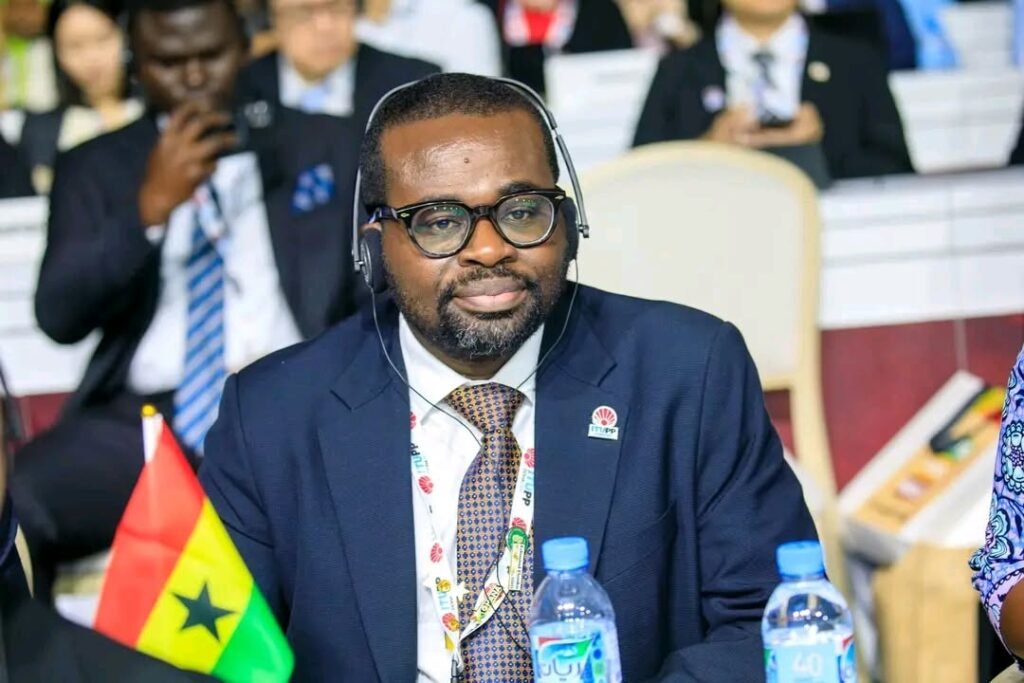
Methodist Church Ghana minister and Director-General of the National Communications Authority (NCA), Rev. Ing. Edmund Yirenkyi Fianko, has been re-elected to serve a second four-year term on the International Telecommunication Union (ITU) Radio Regulations Board (RRB), extending his contribution to global efforts to regulate the use of radio-frequency spectrum and satellite orbit resources.
The election took place on Monday, 16 November 2026, during the ITU Plenipotentiary Conference (PP-26) in Doha, Qatar, where Member States voted on the composition of the ITU Council and membership of the Radio Regulations Board for the next four years.
Rev. Ing. Fianko was elected alongside candidates from Botswana and Morocco to occupy the seats allocated to Region D (Africa), reaffirming international confidence in his technical expertise, regulatory experience and leadership in the global communications industry.
His re-election follows his initial election in 2022 for the 2023–2026 term and provides continuity in Ghana’s participation in one of the ITU’s key technical and regulatory decision-making bodies.
As Director-General of the NCA, Rev. Ing. Fianko provides strategic leadership in regulating Ghana’s communications industry, overseeing matters relating to spectrum management, telecommunications infrastructure, technological development and the delivery of efficient and reliable communications services.
His professional background as an engineer, combined with his experience at the highest level of communications regulation, brings technical and policy perspectives to the Board’s deliberations.
His understanding of the practical challenges confronting national regulators, particularly in coordinating spectrum use, addressing harmful interference and accommodating the growing demand for wireless services, is expected to be relevant to the Board’s work.
His continued presence on the Board also provides an opportunity for perspectives from Ghana and the wider African communications landscape to contribute to international discussions on spectrum governance, satellite orbit coordination and the equitable and efficient use of radio-frequency resources.
The Radio Regulations Board is an independent body within the ITU’s Radiocommunication Sector (ITU-R), comprising 12 elected members drawn from different regions of the world. Members serve in their personal capacities and independently of their respective countries.
The Board plays a critical role in ensuring the effective application of the Radio Regulations, the international treaty governing the use of radio-frequency spectrum and satellite orbits.
Among its responsibilities is approving the Rules of Procedure used by the ITU Radiocommunication Bureau in applying the Radio Regulations, as well as registering frequency assignments made by Member States.
It also considers unresolved cases of harmful interference between radio communication services, addresses matters that cannot be settled through the normal application of the Radio Regulations, reviews appeals against decisions of the Radiocommunication Bureau and provides advice to World and Regional Radiocommunication Conferences.
The importance of the Board’s work continues to grow as the global expansion of wireless services, satellite communications, broadband connectivity and emerging technologies creates increasing competition for limited spectrum resources.
Radio-frequency spectrum is a finite natural resource that supports a wide range of essential services, including mobile telecommunications, broadcasting, aviation, maritime communications, satellite operations and emergency response systems.
Without effective international coordination, the increasing number of communication systems operating across national borders could result in harmful interference, disrupting essential services and limiting the efficient use of available frequencies.
The Board therefore serves as an important platform for international cooperation, helping to resolve regulatory challenges, promote efficient spectrum utilisation and support the sustainable development of global communications.
Rev. Ing. Fianko’s re-election is a recognition of his experience and the value of sustained technical expertise in international spectrum governance. It also reinforces Ghana’s longstanding participation in the work of the ITU and its commitment to contributing to the development of an inclusive, efficient and sustainable global digital ecosystem.
For The Methodist Church Ghana, his re-election also brings international recognition to one of its ministers whose professional engagement extends into the highly specialised field of telecommunications regulation and governance.
The new four-year term will provide Rev. Ing. Fianko with another opportunity to contribute to the Board’s mandate while strengthening international cooperation in the management of radio-frequency spectrum and satellite orbit resources.
As countries continue to expand their digital infrastructure and embrace emerging communication technologies, the work of the ITU Radio Regulations Board is expected to remain central to ensuring that the world's shared communications resources are managed efficiently, equitably and sustainably.